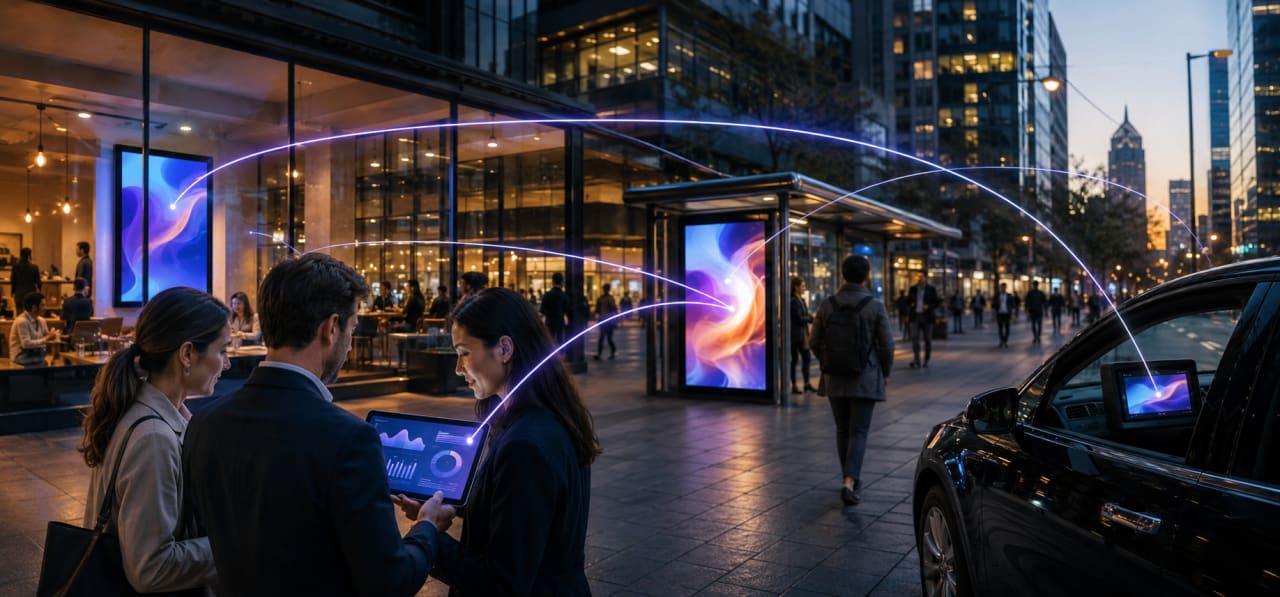
Google's Business Agent for Leads answers a prospect's questions inside the ad and captures their details there. The argument about whether the MQL is dead has missed the actual change: its point of origin is being outsourced.
For twenty years the shape of B2B demand capture has been fixed. An ad buys a click. The click lands on a page you own. The page carries a form you designed, writing to a database you control. Everything downstream — scoring, routing, attribution, nurture — assumes that sequence.
At Google Marketing Live on 20 May 2026, that sequence was quietly shortened by one step.
What was announced
The centrepiece for lead generation is Business Agent for Leads: a Gemini-powered chat unit that sits inside the ad, grounded in the advertiser's own website content. It answers a prospect's questions around the clock and captures their details in the conversation — while, as Google frames it, the marketing team is offline.
It did not arrive alone. Google also shipped Leads in Google Ads, a native lead management surface; lead intent scores for spam filtering and quality ranking; lead journey mapping; and journey-aware bidding. The framing in Google's own materials is worth quoting because it tells you what the product is really arguing: lead quality problems are "not sales problems… they are measurement, quality, and design problems."
Alongside it, a hard operational date that has had far less attention than it deserves: Dynamic Search Ads upgrade mandatorily to AI Max by September 2026. Any B2B search programme still running DSAs has a migration to plan, this quarter.
One figure to handle carefullyGoogle's claim that 75 per cent of people report making faster, more confident decisions using AI Mode is self-reported survey perception, not behavioural data — Google's own post flags it as such. It is being repeated in trade coverage without the qualifier.
The change nobody is naming
The trade conversation this year has been about whether the MQL is dead. It is the wrong question, and the evidence for it is thin — of which more below.
The real shift is that the lead record is now created inside someone else's system. Not scored there. Created there. The conversation that produced it happened on a surface you do not own, was conducted by a model you cannot inspect, drew on a grounding of your website content you did not curate for that purpose, and reached you as a structured record after the fact.
Every first-party data strategy of the last four years has been built on owning the moment of capture. This moves the moment of capture off your property — and it is being sold as a conversion-rate improvement.
To be fair to the product: it will very probably lift capture rates. Answering a prospect's specific question at 11pm beats a form that asks for their phone number. The friction reduction is real, and for high-volume, lower-consideration B2B categories it may be straightforwardly good.
The cost is in what you cannot see afterwards. You do not have the transcript of what the prospect asked, which is the highest-signal artefact in the entire interaction — it tells you the objection, the comparison set, the use case, the vocabulary. In the old sequence, that intelligence surfaced through the pages they visited and the questions they typed into your site search. In the new one, it stays with the intermediary, and you receive the residue: a name, a company, a score.
Visual 1 — Where the lead record is born
Landing page and form | In-ad conversational agent | |
|---|---|---|
Capture surface | Owned property | Ad platform surface |
Questions asked by the prospect | Inferable from behaviour and site search | Held by the platform; not delivered to you |
What answered them | Your copy, versioned and approved | A model grounded in your site, ungoverned at the response level |
Qualification logic | Yours; auditable; testable | Platform lead intent score; not inspectable |
Consent and disclosure | Your notice, your record | Shared responsibility, and in the EU an AI-disclosure duty applies to the interaction |
If you leave the platform | The mechanism is yours and keeps working | Capture, scoring history and conversational context go with it |
Optimisation loop | You test copy against outcomes | The platform tests responses against its own objective |
How to read it: The rows that matter are the last three. Consent, portability and whose objective the optimisation serves are structural questions, not feature comparisons — and none of them are visible in a performance test of the unit.
The MQL is not dying, and the data does not say it is
It is worth being blunt about the evidence, because a great deal of confident commentary this year rests on nothing.
We found no credible, dated 2026 measurement of form-fill volume declining because of AI agents, of agents completing B2B lead forms at scale, or of MQL quality degrading in a way attributable to agents. The most-circulated supporting figure — that 98 per cent of website traffic never converts — appears in a sponsored webinar description from January 2026 with no cited source, researcher or methodology. It should not be printed as a statistic, and it is being printed constantly.
The available telemetry points the other way. HUMAN Security's monthly agentic-traffic data shows agents concentrated on product and search routes — 76 to 79 per cent — and appearing on checkout routes only 2.3 to 2.4 per cent of the time. Agents are researching. They are not, yet, transacting or converting at any scale.
What buyers are doing is better evidenced. Gartner research presented on 20 May 2026, from a survey of 645 B2B buyers fielded in late 2025, found 69 per cent validate AI-generated insights with a sales rep, 45 per cent had used generative AI mainly to research vendors, and 67 per cent nonetheless prefer a rep-free experience. Forrester's 2026 buyer research puts AI use in purchase decisions at 94 per cent, up from 89, with twice as many buyers rating generative AI a more meaningful source than vendor websites.
Read those together and the picture is not the death of the qualified lead. It is buyers doing more research in interfaces you do not control, then still wanting a person — which is precisely the demand an in-ad agent is designed to intercept.
The other end of the market moved too
On 14 May 2026, Microsoft Advertising became the third activation route for LinkedIn professional targeting in connected TV, after Amazon DSP was formalised on 7 May and The Trade Desk before it. LinkedIn first-party data routes through Microsoft Monetize into private marketplace deals, targetable on industry, job function and company category.
The entry price is the story: a minimum $50,000 over 30 days, a minimum audience of one million members, US only, with deal IDs taking up to five business days and CTV Select carrying a $100,000 minimum per ad set. "CTV for B2B" has been discussed as an emerging channel for three years. It has emerged as an enterprise-only one, and mid-market B2B is priced out for now.
There is an awkward adjacency worth noting. Lunio's invalid-traffic study published in June 2026 measured LinkedIn's invalid traffic rate as the highest of any major platform across the period it covered. Buying LinkedIn's audience data in a premium CTV environment while LinkedIn's own click environment carries that ranking is not a contradiction — different inventory, different mechanics — but it is a reasonable question to put to a rep.
What to do about the ad-unit capture point
Test it, but instrument the gap. Compare in-ad captured leads against form leads on downstream conversion to opportunity and to closed-won, not on cost per lead. Cost per lead will favour the agent almost by construction.
Ask, in writing, what you get from the conversation. Transcript access, question-level data, or nothing? The answer determines whether this is a capture channel or an intelligence blackout, and it is the single most important commercial question about the format.
Govern the grounding. The agent answers from your website content. That means your outdated pricing page, your unreviewed FAQ and your three-year-old comparison table are now, in effect, live sales collateral being spoken aloud to prospects. Audit what it can reach before you run it.
Handle EU disclosure now. Article 50 of the EU AI Act has applied since 2 August 2026, and a conversational AI unit interacting with an EU-based person falls within the duty to disclose that they are dealing with an AI system. Whether the platform or the advertiser carries that duty in any given configuration is worth a direct answer rather than an assumption.
Plan the AI Max migration this quarter. September is not far, and a forced upgrade during a quarter-end demand push is a bad way to discover what changed.
None of this is an argument for refusing the format. Capture friction is real and reducing it is worth money. It is an argument for pricing the trade honestly: you are exchanging the richest signal in your funnel for a higher conversion rate on a surface you do not own. That may well be worth it. It is currently being decided by nobody, because it looks like an ad setting.
Sources and method. A MarketingHubMedia original. Google Marketing Live announcements, 20 May 2026: Google and PPC Land, 21 May 2026 (Business Agent for Leads, Leads in Google Ads, lead intent scores, journey-aware bidding, DSA to AI Max upgrade by September 2026). Google's 75 per cent AI Mode figure is self-reported survey perception, flagged as such in Google's own post. Microsoft/LinkedIn CTV activation per PPC Land, 14 May 2026, including stated minimums. Buyer research: Gartner, 20 May 2026 (n=645, fielded August–September 2025 — note the fieldwork is not current); Forrester, The State of Business Buying 2026, 21 January 2026 (sample size and methodology gated). Agent route distribution from HUMAN Security, June 2026. Invalid-traffic platform ranking from Lunio's Invalid Traffic Impact Report, June 2026, via PPC Land; Lunio sells invalid-traffic filtering. EU AI Act Article 50 application per the European Commission, 2 August 2026. We found no credible dated 2026 measurement of declining form-fill volume attributable to AI agents; the widely-circulated "98 per cent of traffic never converts" figure traces to a sponsored webinar description with no disclosed methodology and is not cited here as data. Journalism, not procurement advice. Corrections will be made openly on this article.